
Process Optimisation
Analysis and redesign of production and operational processes to improve throughput, reduce manual handling and prepare workflows for phased automation.
What Is Process Optimisation?
Process optimisation is the analysis-and-readiness side of industrial automation — and to be clear before anything else: RoboHub Africa advises on, sources and supports automation vendor-neutrally — it is not a consumer-robotics, robotics-education or RPA-software vendor. We ready manufacturers’ and institutions’ processes for automation across Ghana and Togo. Book a readiness assessment — or request an automation advisory: +233 20 531 3333.
Process optimisation is the structured analysis and deliberate redesign of production and operational workflows to remove friction, reduce unnecessary manual handling, and establish the operational conditions under which automation can be introduced effectively. It is not simply the elimination of waste — it is the disciplined reengineering of how work moves through an organisation, from raw input to finished output, so that each stage is coherent, measurable, and ready for the next level of capability.
Manufacturers, logistics operators, food producers, healthcare facilities, and research institutions across Ghana and Togo specify this service when they recognise that deploying automation into an unoptimised process produces diminishing returns. Before any robotic cell, conveyor system, or automated workflow is committed to, the underlying process must be sound. RoboHub Africa’s process optimisation practice ensures that organisations build their automation future on a foundation that is analytically rigorous and operationally defensible.

When to Specify Process Optimisation
Process optimisation is appropriate at several distinct inflection points in an organisation’s operational life. It is most commonly specified ahead of a planned automation programme — where the objective is to ensure that the incoming technology maps to a well-defined process rather than inheriting the inefficiencies of an undocumented one. It is equally relevant for organisations experiencing throughput plateaus, quality inconsistencies, or rising labour costs that cannot be resolved through incremental operational adjustments.
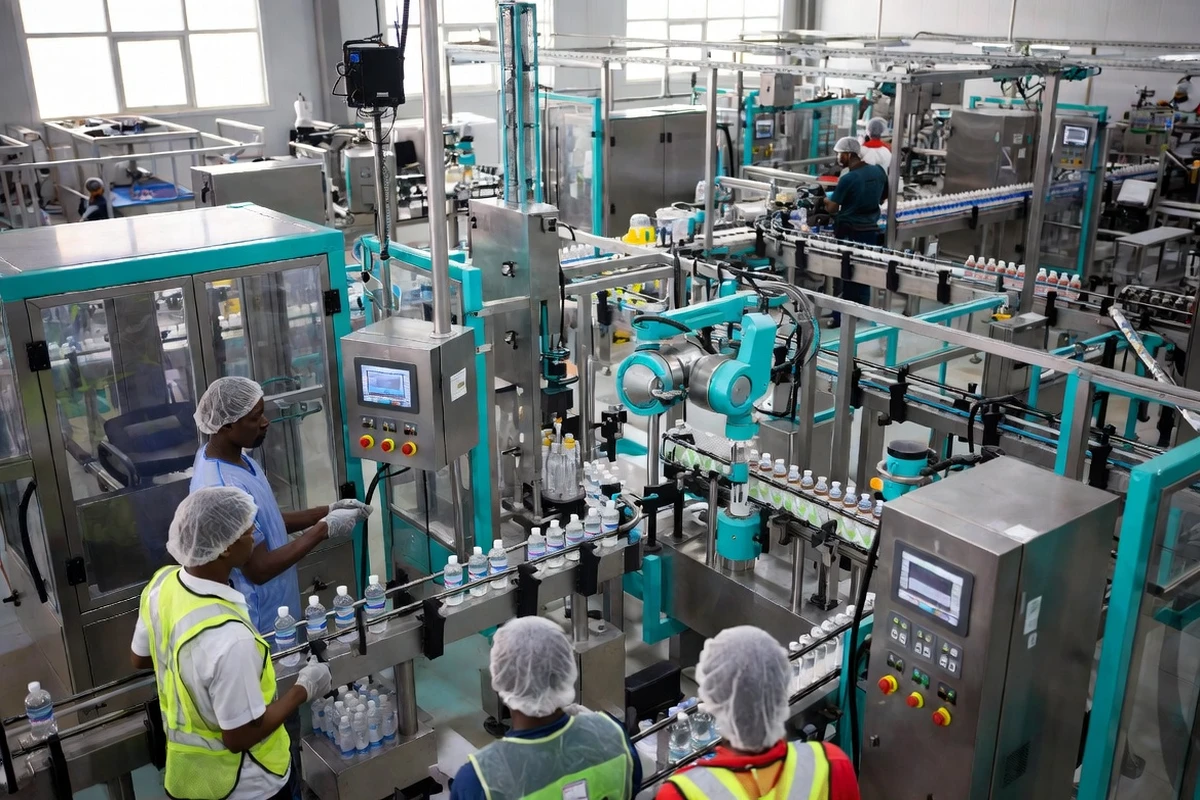
Across Ghana and Togo, this service has direct relevance for food and beverage producers managing high-volume repetitive lines, pharmaceutical and healthcare facilities operating under regulatory process requirements, third-party logistics operators seeking to reduce dwell times and manual sortation, and light manufacturers preparing for phased capital investment in automation.
Methodology — The RoboHub Africa Specialist Approach
-
Process Discovery and Scoping — Specialists conduct structured interviews with operational leads and production managers to map the current-state workflow end to end. Bottlenecks, handoff gaps, and manual intervention points are catalogued without assumption.
-
On-Site Process Observation — The team carries out direct floor-level observation across shifts to validate what the documentation describes against what actually occurs. Variation, workarounds, and informal practices are recorded systematically.
-
Analytical Review and Opportunity Identification — Collected data is reviewed against throughput targets, cycle-time expectations, and the organisation’s stated automation objectives. Optimisation opportunities are ranked by impact and implementation readiness.
-
Redesign and Workflow Modelling — A revised process architecture is developed, presenting the proposed future-state workflow with clearly defined stages, decision points, and handoff protocols. Where phased automation is planned, the model identifies exactly where technology enters the workflow.
-
Transition Roadmap and Handover — The engagement concludes with a structured transition document: a prioritised action plan, implementation sequencing, and a briefing prepared for the organisation’s internal teams and, where relevant, subsequent RoboHub Africa deployment specialists.
Scope, Standards and Analytical Rigour
- Workflow documentation delivered in structured, revision-controlled formats suitable for engineering and procurement review
- Observation methodology applied consistently across production and logistics environments
- Redesign outputs aligned to the organisation’s sector-specific operational and regulatory context
- Process models built to accommodate phased automation without requiring fundamental rework
- Engagement conducted entirely within Ghana and Togo operational footprints
Outcomes
A completed process optimisation engagement delivers clarity where complexity previously obscured decision-making. Operational leads gain a documented, coherent process architecture that supports confident investment in automation. Throughput constraints are identified and sequenced for resolution. Manual handling is reduced by design, not by instruction. And the organisation moves toward its automation programme with a process foundation that has been independently verified rather than assumed.
Engagements are scoped, delivered, and handed over with a structured post-engagement review period during which RoboHub Africa specialists remain available to address implementation queries.
Related Services and Solutions
Organisations that have completed a process optimisation engagement commonly proceed to advisory, integration and managed-support engagements.
Related Services
- Automation Readiness Assessment — decide before you build
- Automation Advisory & Provisioning — the roadmap
- Systems Integration — vendor-neutral integration advisory + oversight
- Industrial Automation Advisory & Managed Support — the full advisory + lifecycle picture
Advisory to Standard
- We advise to recognised practice — lean and Overall Equipment Effectiveness (OEE) measurement, ISA-95 process modelling, and the relevant sector-specific quality frameworks — described as the framework we work to, with certifications claimed only where actually held, and within Ghana’s Factories, Offices and Shops Act 1970 (Act 328) / DFI safety regime
- Vendor-neutral — our analysis serves your interest, not a single vendor’s
- Established 2020 — a real automation advisory & managed-support partner, not a consumer-robotics or software-RPA vendor
- An engagement is scoped and quoted per engagement — there is no flat published rate, and we never quote an invented figure