The problem
Institutional buyers need a documented, HSE-disciplined source for automation maintenance.
Our approach
Automation Maintenance
Automation Maintenance delivered to institutional standard — structured procurement, chain-of-custody discipline, documented handover.
The Challenge
Automation systems do not depreciate uniformly. Conveyor drives, robotic arms, PLC-controlled lines, and sensor networks each carry their own degradation profiles — and in the absence of structured maintenance discipline, the earliest failures tend to arrive precisely when production pressure is highest. For manufacturers across Ghana and Togo, this pattern is a familiar and costly one: equipment is commissioned with care, then handed to operational teams whose primary mandate is throughput, not preventive discipline.
The consequence is rarely a sudden catastrophic failure. More often it is incremental: a sensor recalibration deferred, a firmware update bypassed, a mechanical tolerance allowed to drift. Individually, each decision appears reasonable. Collectively, they erode the reliability margin that automation was procured to create. For food producers operating under hygiene-critical conditions, healthcare facilities relying on precision dispensing systems, and logistics operators whose throughput depends on uninterrupted conveyor and sortation lines, that erosion is not an operational inconvenience — it is a direct risk to production integrity.
The underlying problem is rarely equipment quality. It is the absence of a structured, institutionally managed maintenance framework — one that treats automation assets with the same rigour applied to their initial procurement and deployment.
The RoboHub Africa Solution
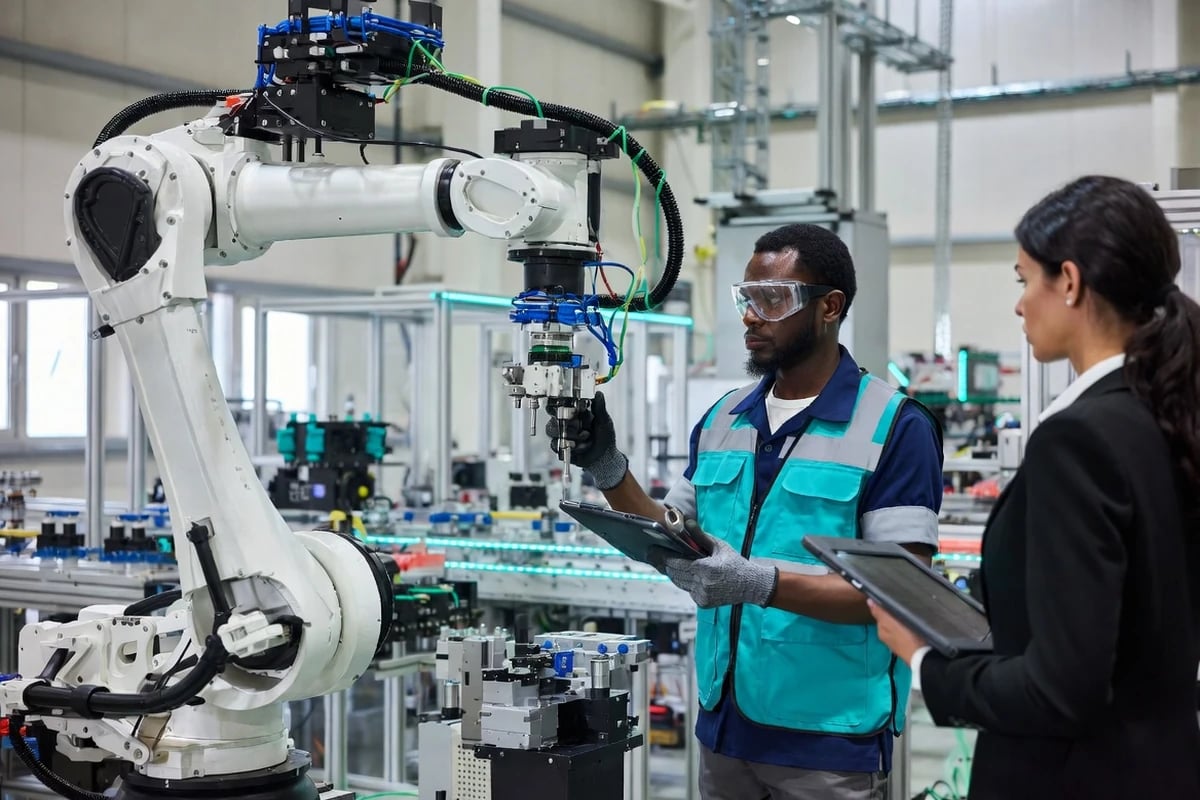
RoboHub Africa delivers automation maintenance as a managed discipline, not a reactive callout service. Engagements begin with a documented baseline assessment: every system in scope is inventoried, its operational history reviewed, and its current condition recorded against manufacturer tolerances. This baseline becomes the foundation for a structured maintenance schedule calibrated to the specific duty cycles, environmental conditions, and criticality classifications of each asset.
Scheduled interventions follow a chain-of-custody protocol — each visit is planned, each finding is documented, and each corrective action is recorded against the asset register. Nothing is left to institutional memory. Clients receive structured maintenance reports that track asset condition over time, surfacing trend data that enables informed capital planning decisions before failures occur.
Where remote monitoring infrastructure is in place, RoboHub Africa integrates condition data into the maintenance cycle, allowing scheduled interventions to be adjusted on evidence rather than elapsed time alone. The result is a maintenance posture that is both systematic and responsive — reducing unplanned downtime without the overhead of over-servicing assets that are performing within specification.
Service Specification
- Documented baseline assessment against manufacturer tolerances and site-specific duty cycles
- Structured preventive maintenance scheduling calibrated to asset criticality and operational environment
- Chain-of-custody intervention records with full traceability per asset
- Firmware, software and control-system update management coordinated to minimise production disruption
- Condition trend reporting delivered to a nominated technical and operational contact
- Escalation protocols for fault identification, parts coordination and corrective intervention within Ghana and Togo
Typical Engagement Profile
A standard managed maintenance engagement covers a defined portfolio of automation assets — typically spanning a single production facility or logistics operation — with scheduled visits structured across a twelve-month cycle. Sectors most frequently served include food and beverage manufacturing, pharmaceutical production, healthcare facility operations, and warehouse or distribution centre management. Engagements are scoped following the baseline assessment, with service frequency and documentation depth agreed to reflect the operational criticality of the systems under management.
Outcomes
- Sustained automation reliability through structured preventive discipline rather than reactive intervention
- Auditable asset maintenance records supporting quality management, regulatory compliance and capital planning
- Reduced unplanned downtime by addressing drift and degradation before operational thresholds are breached
- Operational teams freed to focus on throughput, with maintenance accountability held by a dedicated specialist function
- Informed asset lifecycle decisions supported by trend data accumulated across the maintenance programme