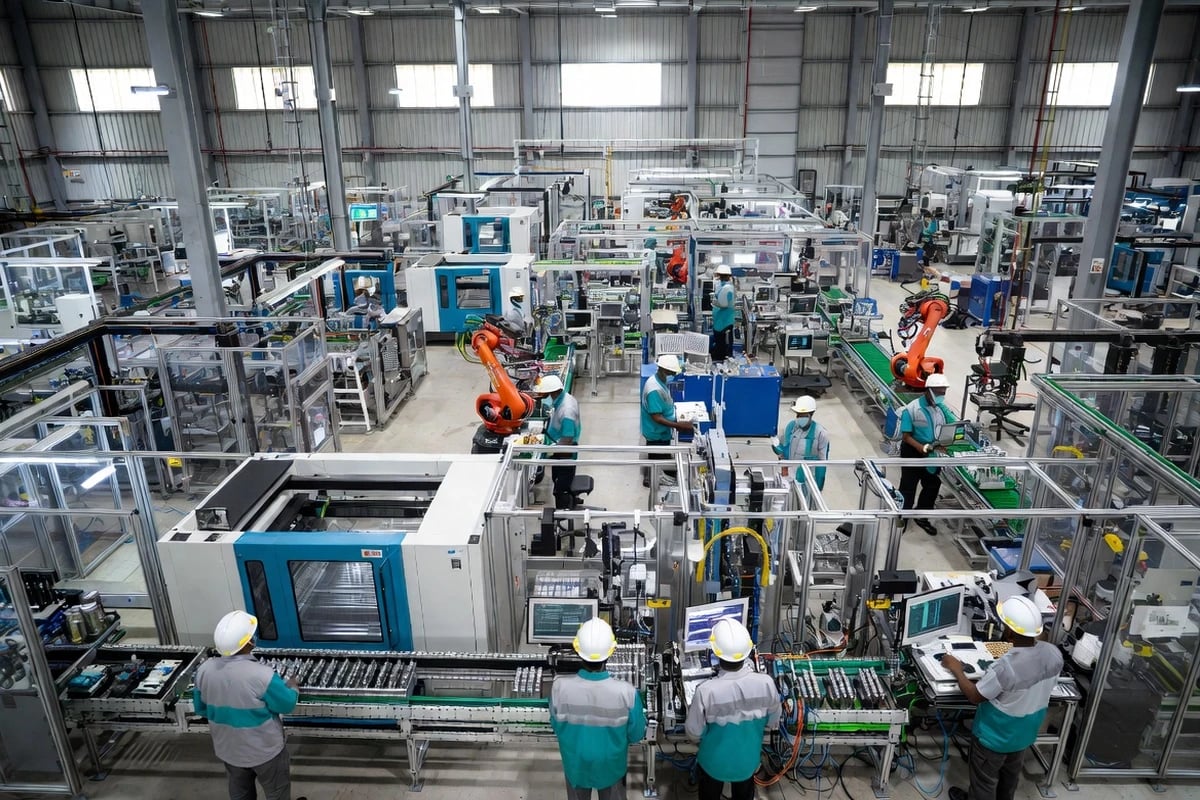
Why Manufacturing Facilities Specify RoboHub Africa
Manufacturing operations in Ghana and Togo face a distinct set of pressures — rising input costs, workforce variability, quality consistency demands from downstream buyers, and the expectation of uninterrupted throughput across multiple shifts. Addressing these pressures through ad hoc automation procurement typically produces fragmented outcomes: isolated islands of technology that do not integrate, generate data, or compound in value over time. RoboHub Africa works within this environment as an advisory and enablement partner, helping production teams move from reactive technology decisions toward a structured, phased automation programme aligned to their actual process constraints.
The manufacturing sector rewards methodical transition. Facilities that attempt wholesale automation in a single cycle routinely encounter integration failures, operator skill gaps, and unplanned downtime — outcomes that erode the very efficiency gains they sought. RoboHub Africa’s model is built around a phased engagement rhythm: assess, design, deploy, train, and sustain. Each phase is governed, documented, and handed back to the client with full operational clarity.
Specification Requirements Unique to Manufacturing
Manufacturing automation in the Ghana and Togo context carries requirements that differ meaningfully from textbook deployments. Power infrastructure variability, ambient temperature and humidity in production environments, the mix of legacy equipment already on the floor, and the availability of qualified maintenance personnel all shape what is technically appropriate. A specification that performs in a climate-controlled European assembly facility may require significant adaptation to function reliably within a West African production environment.
Regulatory considerations in both jurisdictions — including occupational health and safety standards, product quality certification requirements for export-facing manufacturers, and sector-specific environmental obligations — are embedded into the advisory process from the outset. RoboHub Africa’s specialists do not design automation programmes in isolation from the compliance landscape. Every recommended configuration accounts for the operational, regulatory, and human-factor conditions that govern the facility in question.
Recommended Services for Manufacturing
- Automation Needs Assessment — a structured process audit that maps current production flows, identifies automation-ready transition points, and establishes a phased deployment roadmap
- Systems Integration Advisory — ensuring new automation components interface reliably with existing production equipment, ERP systems, and quality management processes
- Operator Training and Enablement — hands-on capability transfer to production and maintenance personnel, reducing dependence on external technical support
- Managed Automation Support — ongoing monitoring, performance reporting, and intervention response to sustain production performance across operational cycles
- Process Optimisation Review — periodic structured assessments that identify recalibration opportunities as production volumes, product lines, or regulatory requirements evolve
Notable Project Types
RoboHub Africa has supported manufacturing engagements spanning mid-scale food processing facilities transitioning from manual to semi-automated packaging and quality inspection lines; industrial goods producers introducing controlled-environment assembly processes to meet export certification benchmarks; and pharmaceutical-adjacent manufacturing facilities requiring validated automated dispensing and batch-tracking workflows. In each case, the engagement scope extends beyond equipment — it encompasses the process logic, the workforce transition, and the governance structures that allow the facility to own and sustain its automation investment.
Larger-scale engagements have included multi-site manufacturers in Ghana coordinating phased rollouts across several production facilities, where programme governance and cross-site knowledge transfer were as consequential as the technology itself. The pattern across these project types is consistent: durable automation outcomes are produced by disciplined advisory process, not by hardware selection alone.
Compliance and Standards Considerations
- Occupational health and safety compliance requirements applicable to automated production environments in Ghana and Togo
- Product quality and traceability standards relevant to export-facing manufacturers, including food safety and pharmaceutical-adjacent processing
- Environmental and waste management obligations for production facilities operating under applicable national regulatory frameworks
- Data integrity and system audit-trail requirements for facilities subject to quality management certification processes
- Power and electrical infrastructure standards governing the integration of automated systems into existing facility utilities
- Workforce competency and change-management protocols aligned to responsible technology transition obligations
Automation Advisory for Manufacturing
To be clear about what this is: RoboHub Africa is an industrial automation advisory, enablement, sourcing and managed-support partner for manufacturing — not a consumer-robotics, robotics-education, or RPA-software vendor. We advise on what to automate, source the right technology vendor-neutrally, enable the deployment, and keep it running. Recommended standards (e.g. IEC 61131-3, ISO 10218-2 / ISO 12100, IEC 62443 for OT cybersecurity) are described as the framework we work to — certifications and OEM-partner badges are claimed only where actually held — and all work sits within Ghana’s Factories, Offices and Shops Act 1970 (Act 328) / DFI safety regime. We serve manufacturers across Ghana, Togo (Lomé) and the wider West-African market.
Related Services
- Industrial Automation Advisory & Managed Support — the full advise-source-support programme
- Automation Readiness Assessment — decide before you build
- Automation Advisory & Provisioning — the sequenced roadmap
- Managed Automation Support — SLAs, uptime, accountability
- Process Optimisation — throughput, OEE, capability-building
Advisory to Standard
We advise and support to recognised practice — vendor-neutral, with certifications claimed only where actually held, and within Ghana’s Factories Act 328 / DFI safety regime. We quote against your actual requirement, never an invented figure.
Book a readiness assessment — or request an automation advisory: +233 20 531 3333.