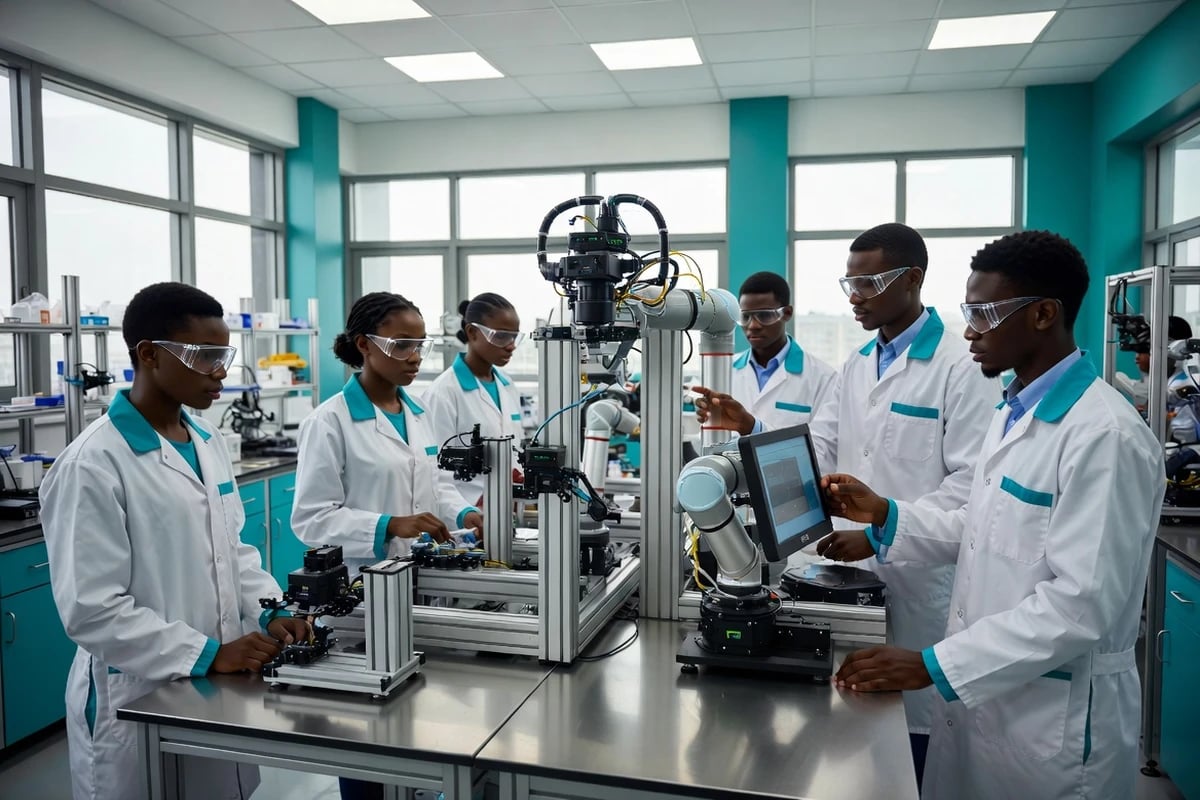
Why Educational Institutions and Research Centres Specify RoboHub Africa
Automation literacy is rapidly becoming a foundational requirement across Ghana and Togo’s post-secondary and research landscape. Universities, polytechnics, vocational institutions, and applied research centres are under increasing pressure to equip their students, faculty, and staff with hands-on capability in robotics, process automation, and industrial control systems — not merely theoretical familiarity, but deployable technical competence. RoboHub Africa works directly with institutional leadership and academic programme coordinators to design automation enablement journeys that align with curriculum objectives, research mandates, and laboratory infrastructure realities.
The distinction between generic technology training and a structured automation programme is significant. RoboHub Africa does not deliver off-the-shelf workshops. Each engagement is scoped against the institution’s academic calendar, existing laboratory assets, discipline focus — whether engineering, agri-technology, health sciences, or applied logistics — and the level of technical foundation already present among learners. The result is a capability-building pathway that holds up under academic rigour and translates into genuine competency for graduates entering Ghana and Togo’s industrial and institutional economy.
Specification Requirements Unique to Educational and Research Engagements
Academic and research institutions operate within procurement governance frameworks that prioritise curriculum alignment, safety compliance, and long-term equipment utility over short-cycle commercial procurement. Automation programme design must satisfy departmental learning outcome requirements, internal ethics and laboratory safety protocols, and in some cases sector accreditation bodies overseeing engineering or applied science programmes. RoboHub Africa structures its advisory engagements with full awareness of these institutional constraints, ensuring that recommended hardware platforms, software environments, and training sequences can be formally documented for academic governance review.
Research-grade deployments add a further layer of specification rigour. Where institutions are operating automation infrastructure in support of active research projects — crop monitoring systems, bioprocessing laboratory automation, or logistics simulation environments — the advisory scope extends into data integrity, repeatability of automated processes, and interfacing with existing research data management systems. Every recommendation is made with the institution’s published research agenda in mind, not a generalised product catalogue.
Recommended Services for Educational and Research Institutions
- Automation Curriculum Advisory — structured programme scoping aligned to department learning outcomes and accreditation requirements
- Laboratory Automation Enablement — advisory and configuration support for research-grade automation infrastructure within institutional laboratory settings
- Faculty and Technical Staff Training — specialist-led capability development for educators and laboratory technicians who will deliver and maintain automation programmes
- Student Cohort Training Programmes — hands-on automation skills delivery designed for undergraduate, postgraduate, and vocational learner cohorts
- Ongoing Managed Support — continuous advisory and technical support to sustain automation infrastructure and curriculum relevance across academic cycles
Notable Project Types
RoboHub Africa has structured automation enablement engagements across a range of academic and research contexts within Ghana and Togo. A representative pattern includes polytechnic engineering departments seeking to introduce PLC programming and industrial robotics modules into their core curriculum — engagements that span initial equipment specification advisory, faculty training, and a structured first-cohort student programme. In applied research settings, RoboHub Africa has provided advisory support to institutions establishing automated laboratory workflows, with particular attention to process repeatability and operator competency certification at the departmental level.
Research centre engagements often involve multi-phase advisory: an initial diagnostic of existing infrastructure and research workflow requirements, a capability gap assessment against the institution’s stated research objectives, and a phased enablement plan that builds in-house specialist capacity progressively. The objective across all institutional engagements is the same — that when RoboHub Africa’s advisory mandate concludes, the institution’s own faculty and technical staff are equipped to sustain, adapt, and extend their automation capability independently.
Compliance and Standards Considerations
- Alignment with national curriculum frameworks and qualification authority requirements in Ghana and Togo
- Laboratory safety protocol compliance governing automation and robotics equipment in academic settings
- Research data integrity standards relevant to automated data collection and process logging
- Procurement governance documentation suitable for institutional tender and committee review processes
- Faculty and staff competency documentation structured for departmental records and accreditation audits
- Ethical use and responsible deployment standards for automation in research contexts involving human subjects or sensitive data
Automation Advisory for Education & Research
RoboHub Africa’s role here is to advise, enable, source and support institutional automation infrastructure — assessing laboratory and curriculum needs, advising what to deploy and to what standard, sourcing the right platforms vendor-neutrally, and building faculty and technical-staff capability to sustain it. To be clear: this is industrial and laboratory automation enablement and capability-building for an institution’s own programmes — it is not a packaged consumer-robotics or robotics-education product line, and not software-RPA. The deliverable is your team’s competence and a maintainable automation estate.
Related Services
- Industrial Automation Advisory & Managed Support — the full advise-enable-source-support programme
- Automation Readiness Assessment — decide before you build
- Technology Sourcing & Fulfilment — the right platforms + partners, vendor-neutral
- Robotics Enablement & Deployment — laboratory and teaching-cell enablement
- Managed Automation Support — sustained support across academic cycles
Advisory to Standard
We advise and support to recognised practice — laboratory-safety, control-systems and OT-security frameworks (e.g. IEC 61131-3, IEC 62443) described as the framework we work to, with certifications and OEM-partner badges claimed only where actually held — and, for any equipment operated in an industrial or workshop setting, within Ghana’s Factories, Offices and Shops Act 1970 (Act 328) / DFI safety regime. Our advice and sourcing are vendor-neutral, serving the institution’s interest rather than a single supplier’s. Engagements are scoped and quoted per requirement — never an invented figure.
Book a readiness assessment — or request an automation advisory: +233 20 531 3333.