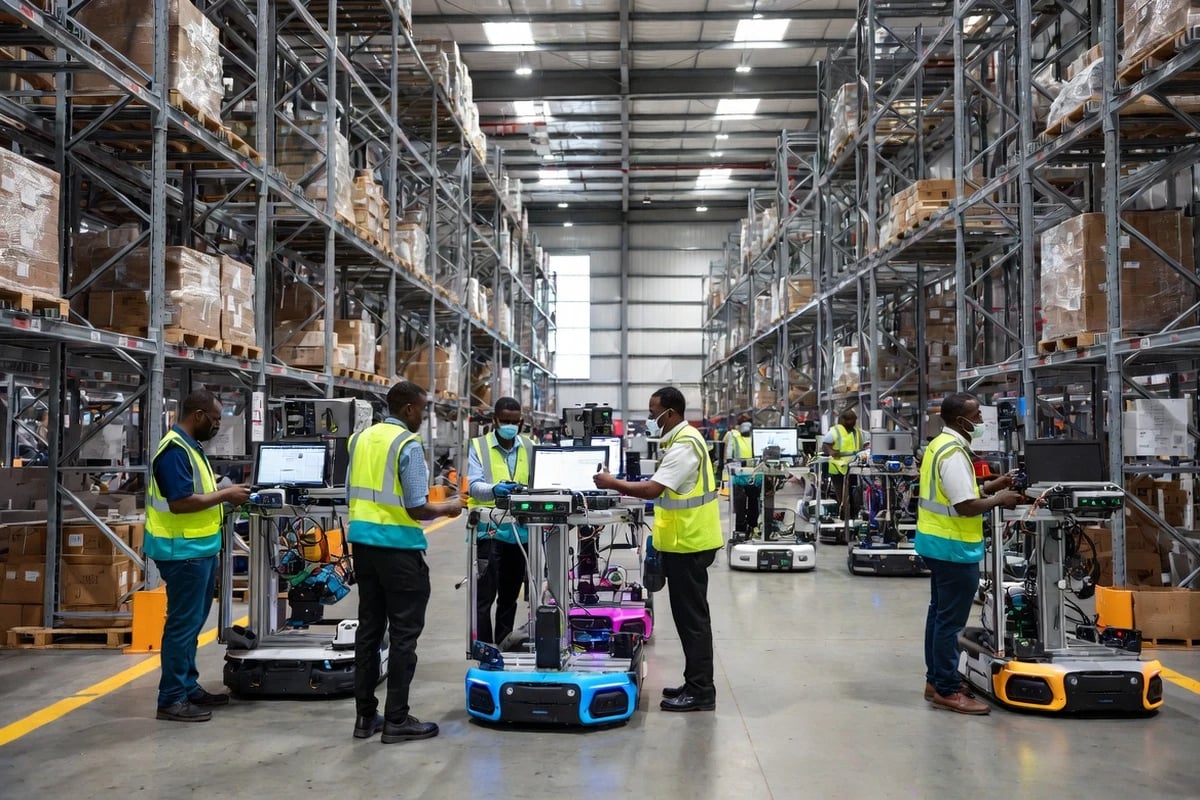
Why Logistics & Warehousing Operators Specify RoboHub Africa
Logistics and warehousing operations across Ghana and Togo operate under sustained pressure — throughput demands rise, labour costs fluctuate, and the margin for handling error tightens with every shipment cycle. Operators who have historically absorbed these pressures through headcount expansion are increasingly finding that approach unsustainable at scale. RoboHub Africa works with logistics and warehousing organisations to replace that structural fragility with engineered automation — from inbound receiving through to dispatch staging — so that operational performance becomes a function of system design rather than daily staffing variance.
The case for automation in this sector is not theoretical. Conveyor sortation, automated guided vehicles, barcode and RFID integration, warehouse management system connectivity, and robotic pick-and-place deployments have matured into deployable, maintainable solutions appropriate for the scale of operations across Accra, Tema, Lomé and their surrounding logistics corridors. RoboHub Africa brings advisory rigour and deployment discipline to ensure that each intervention is scoped correctly, integrated cleanly, and supported continuously.
Specification Requirements Unique to Logistics & Warehousing
Automation deployments in logistics and warehousing environments carry a distinct set of operational constraints that generic technology provisioning does not address. Facilities across Ghana and Togo frequently contend with variable power infrastructure, humidity-sensitive goods categories, mixed-fleet vehicle environments, and warehouse footprints that were not originally designed for automated traffic flows. Any automation specification must account for these realities before deployment — not during commissioning.
RoboHub Africa’s advisory process begins with a thorough operational audit: mapping product flow, identifying bottleneck nodes, assessing existing infrastructure capacity, and aligning automation scope to the client’s throughput targets and capital envelope. This discipline prevents the common failure mode of deploying automation that performs well in isolation but degrades overall throughput because upstream or downstream manual processes were not rebalanced to match the new system’s pace.
Recommended Services for Logistics & Warehousing
- Automation Readiness Assessment — structured operational audit identifying automation opportunity, infrastructure constraints, and phased deployment sequencing
- Conveyor & Sortation System Advisory — specification and integration guidance for inbound, outbound, and internal sortation workflows
- Automated Guided Vehicle (AGV) Deployment — fleet sizing, route mapping, safety integration, and managed onboarding for AGV programmes within warehouse environments
- Warehouse Management System (WMS) Integration — connectivity between automation hardware, inventory platforms, and ERP systems for real-time operational visibility
- Managed Automation Support — ongoing system monitoring, preventive maintenance scheduling, and operational optimisation across the automation estate
Notable Project Types
RoboHub Africa has delivered automation programmes across logistics and warehousing contexts that range from single-facility conveyor modernisation to multi-zone AGV deployments serving large-format distribution centres in the Tema industrial corridor. A representative engagement involves a bonded warehousing operator requiring parallel throughput streams for ambient and temperature-sensitive goods — a configuration that demands careful zoning, system segregation, and WMS logic capable of managing both flows without cross-contamination of dispatch sequences.
At a different scale, fast-moving consumer goods distributors operating out of Accra’s peri-urban logistics belt have commissioned RoboHub Africa to design semi-automated pick lines that accommodate seasonal volume surges without requiring proportional headcount increases. In each case, the value delivered is not the automation hardware itself but the advisory and integration discipline that ensures the deployed system performs to its specified capability within the client’s actual operating environment.
Compliance & Standards Alignment
- Adherence to occupational safety protocols governing automated vehicle traffic and pedestrian co-habitation in warehouse environments
- Power infrastructure compatibility assessment against Ghana Grid Company supply standards and generator backup requirements
- Data integration practices aligned with Ghana Data Protection Act obligations for operational and client inventory records
- Equipment grounding and electrical safety compliance in accordance with applicable Ghanaian and Togolese electrical codes
- Environmental operating condition verification — temperature, humidity, dust — prior to hardware specification for sensitive automation components
- Change management and operator training protocols ensuring workforce readiness before and after automation go-live
Automation Advisory for Logistics & Warehousing
RoboHub Africa’s role in this sector is to advise, enable, source and support — we assess where the operation stands, advise what is worth automating and in what order, source the right systems vendor-neutrally, and keep them running. We are not a consumer-robotics, robotics-education or software-RPA vendor; this is the advisory and lifecycle side of physical industrial automation for warehouses and logistics hubs across Ghana and Togo.
Related Services
- Industrial Automation Advisory & Managed Support — the full advise-enable-source-support programme
- Automation Readiness Assessment — decide before you build
- Technology Sourcing & Fulfilment — the right system + partners, vendor-neutral
- Robotics Enablement & Deployment — AGV, sortation and pick-and-place enablement
- Managed Automation Support — SLAs, preventive maintenance, uptime
Advisory to Standard
We advise and support to recognised practice — machine-safety and functional-safety frameworks (e.g. ISO 10218-2 / ISO 12100, IEC 62443 for OT) described as the framework we work to, with certifications and OEM-partner badges claimed only where actually held — and within Ghana’s Factories, Offices and Shops Act 1970 (Act 328) / DFI safety regime. Our advice and sourcing are vendor-neutral, serving your interest rather than a single supplier’s. Engagements are scoped and quoted per requirement — never an invented figure.
Book a readiness assessment — or request an automation advisory: +233 20 531 3333.