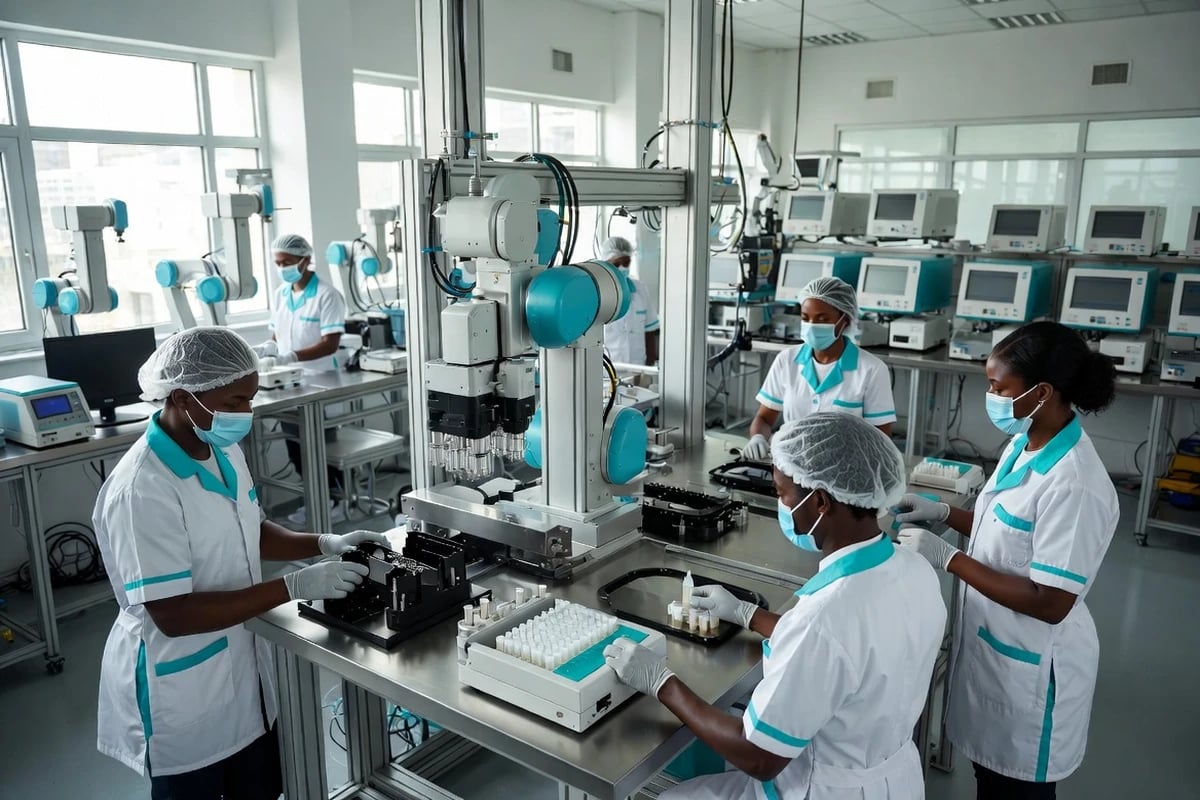
Why Healthcare & Laboratory Environments Specify RoboHub Africa
Automation in healthcare and laboratory settings demands a register of precision that general-purpose industrial deployments rarely encounter. Specimen handling, pharmaceutical dispensing, sterile compounding, and diagnostic workflow management each carry compliance obligations and patient-safety implications that cannot be absorbed into standard operational tolerances. RoboHub Africa approaches these environments with that weight fully understood — advising, deploying, and sustaining automation solutions that are calibrated to the specific procedural and regulatory context of each facility.
Across Ghana and Togo, healthcare institutions and research laboratories face a distinct set of pressures: growing throughput demands, constrained skilled labour availability, and increasing alignment with regional and international regulatory frameworks. RoboHub Africa’s advisory process begins by mapping these pressures against the facility’s existing workflows, identifying automation touchpoints that reduce human error exposure, accelerate cycle times, and strengthen audit readiness — without disrupting the clinical or research environment during transition.
Specification Requirements Unique to Healthcare & Laboratory Environments
Healthcare and laboratory automation operates within a compliance architecture that is fundamentally different from commercial or manufacturing contexts. Sterile zone integrity, chain-of-custody documentation for specimens and pharmaceuticals, contamination prevention protocols, and traceability requirements across every handling stage shape what automation solutions can and cannot do in these settings. Any deployment that does not account for these constraints from the outset creates regulatory exposure rather than operational improvement.
RoboHub Africa’s engagement methodology for this sector begins with a compliance-mapping phase — reviewing the facility’s applicable standards, workflow restrictions, and quality assurance obligations before a single solution is recommended. This ensures that every automated process introduced is documentable, auditable, and aligned with the facility’s standing obligations to regulatory bodies and accreditation frameworks active in Ghana and Togo.
Recommended Services for Healthcare & Laboratory Environments
- Automation Advisory & Workflow Assessment — structured analysis of clinical and laboratory workflows to identify high-precision automation opportunities with compliance-compatible pathways
- Laboratory Process Automation Deployment — scoping and deployment of automated specimen handling, sample sorting, and diagnostic support systems suited to contained laboratory environments
- Pharmaceutical Dispensing & Inventory Automation — configuration of automated dispensing and stock-management systems aligned to pharmacy compliance requirements
- Managed Automation Support — ongoing monitoring, fault response, and performance maintenance for deployed systems within active clinical and research settings
- Staff Enablement & Operational Handover — structured capability transfer programmes ensuring clinical and laboratory teams operate and sustain automated systems with confidence
Notable Project Types
RoboHub Africa has engaged with project types spanning diagnostic laboratory consolidation, pharmaceutical inventory and dispensing automation within hospital-grade pharmacy environments, and specimen logistics workflow redesign in high-throughput pathology settings. These engagements typically involve close coordination with clinical operations leadership, quality assurance teams, and facility compliance officers — moving through advisory, pilot configuration, and staged deployment phases before full operational handover.
Research institution mandates in this sector have included laboratory automation feasibility assessments and the deployment of robotic handling systems within contained research environments, where repeatability and documentation integrity are primary programme objectives rather than throughput volume alone. Across each engagement type, the advisory rigour applied at the front end determines the stability and compliance standing of the outcome.
Compliance & Standards Alignment
- Alignment with healthcare facility accreditation requirements applicable across Ghana and Togo
- Chain-of-custody documentation protocols embedded in automated specimen and pharmaceutical handling workflows
- Sterile and clean-zone procedural compatibility assessed at the advisory stage before deployment
- Audit-ready process documentation produced and maintained across all managed automation engagements
- Quality assurance integration ensuring automated systems operate within the facility’s existing QA framework
- Regulatory reporting readiness supported through traceability architecture built into deployed automation solutions
Automation Advisory for Healthcare & Labs
RoboHub Africa’s role here is to advise, enable, source and support automation for laboratory and diagnostic workflows — specimen handling, sample sorting, pipetting lines, dispensing and inventory — assessing where automation is worth introducing, advising to standard, sourcing the right systems vendor-neutrally, and sustaining them. To be clear: this is industrial and laboratory automation advisory applied to a clinical or research setting — it is not medical-device manufacture, and not a consumer-robotics or software-RPA offering. We advise on automating the process; we do not design, certify or manufacture regulated medical devices.
Related Services
- Industrial Automation Advisory & Managed Support — the full advise-enable-source-support programme
- Automation Readiness Assessment — decide before you build
- Technology Sourcing & Fulfilment — the right system + partners, vendor-neutral
- Robotics Enablement & Deployment — precision specimen-handling and lab-cell enablement
- Managed Automation Support — SLAs, preventive maintenance, uptime
Advisory to Standard
We advise and support to recognised practice — control-systems, functional-safety and OT-security frameworks (e.g. IEC 61131-3, IEC 62443), and quality-system disciplines such as Good Laboratory Practice where the facility operates them — described as the framework we work to, with certifications and OEM-partner badges claimed only where actually held. For automation equipment operated in a workshop or industrial setting, Ghana’s Factories, Offices and Shops Act 1970 (Act 328) / DFI safety regime applies; medical-device and clinical regulatory obligations remain the facility’s own, and we do not claim to discharge them. Our advice and sourcing are vendor-neutral, serving your interest rather than a single supplier’s. Engagements are scoped and quoted per requirement — never an invented figure.
Book a readiness assessment — or request an automation advisory: +233 20 531 3333.
To discuss automation advisory or managed support requirements for a healthcare or laboratory facility in Ghana or Togo, contact RoboHub Africa at info@robohubafrica.com or +233 20 531 3333.