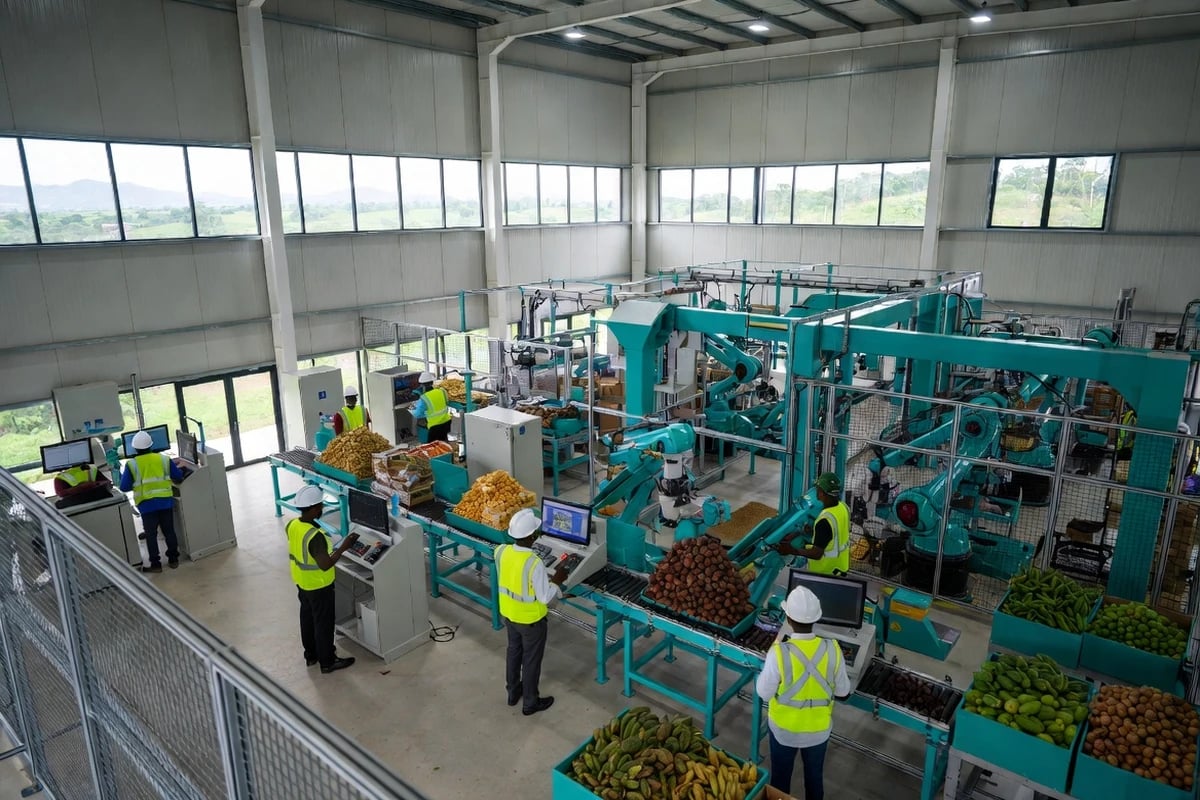
Why Agro-Processing Operations Specify RoboHub Africa
Ghana and Togo’s agro-processing sector operates under conditions that demand more than general-purpose industrial advice. Seasonal harvest surges, variable raw material quality, and the pressure to meet export-grade consistency requirements create a specification environment where imprecise automation produces waste, downtime, and rejected batches rather than the throughput gains the investment was designed to deliver. RoboHub Africa approaches agro-processing mandates with the process discipline those conditions require — mapping each operation’s biological variability, production rhythm, and workforce structure before a single deployment recommendation is made.
The agro-processing clients RoboHub Africa serves — from cereal and grain processors to cocoa secondary processors and vegetable oil facilities across Accra, Kumasi, Tema Industrial Zone, and Lomé — consistently face a shared challenge: automating processes that involve organic, non-uniform inputs within environments that must remain cleanable, auditable, and operable by locally trained personnel. That intersection of complexity is precisely where a specialist automation advisory practice adds institutional value.
Specification Requirements Unique to Agro-Processing
Agro-processing automation carries constraints that do not apply to general manufacturing. Raw material variability — moisture content fluctuation, batch-to-batch size deviation, seasonal contamination risk — means that rigid, fixed-parameter systems routinely underperform in food production contexts. Automation solutions specified for this sector must accommodate adaptive sensing, hygienic design principles, and cleandown cycle integration without creating extended production downtime. Process logic must be built around the biological reality of the material, not the mechanical convenience of the equipment.
Regulatory compliance for food-grade processing in Ghana and Togo additionally governs labelling, traceability documentation, and sanitation audit trails. Automation systems deployed in this context must generate reliable data outputs that support regulatory submissions and export certification processes — not simply accelerate throughput. RoboHub Africa’s advisory methodology accounts for these documentation requirements at the system architecture stage, not as an afterthought.
Recommended Services for Agro-Processing Operations
- Process Automation Consultation — systematic review of existing production line logic, identifying throughput constraints and quality inconsistency points amenable to automation intervention
- Automation System Design and Deployment — specification and commissioning of hygienic-environment-compatible automation systems aligned to primary and secondary processing workflows
- Managed Automation Support — ongoing monitoring, preventive maintenance scheduling, and performance optimisation across operational cycles
- Operator Capability Enablement — structured training programmes that build in-house competence to run, troubleshoot, and adapt automated systems without external dependency
- Traceability and Data Integration Advisory — guidance on integrating automation outputs with production management systems to support regulatory reporting and export documentation
Notable Project Types
Agro-processing mandates undertaken in this sector typically span primary processing facilities handling raw commodity intake — grain milling operations, cassava processing lines, and palm oil extraction facilities where raw throughput volume and consistent quality output are the primary performance criteria. At this scale, automation advisory typically addresses intake handling, sorting and grading logic, and process parameter monitoring to reduce human variability in high-throughput environments.
Secondary processing and value-added production facilities — including cocoa processing operations in the Tema Corridor and packaged food manufacturers supplying both domestic and regional export markets — require a more layered advisory approach. Here, the specification addresses not only throughput automation but also portion accuracy, packaging line integration, and the data trail requirements that accompany export-grade production. RoboHub Africa has delivered phased advisory and deployment engagements across both scales, structuring automation adoption at a pace the client organisation’s technical capacity can absorb and sustain.
Compliance and Standards Considerations
- Ghana Food and Drugs Authority production and labelling compliance requirements relevant to automated food processing lines
- Togo’s Agence Nationale de la Sécurité Sanitaire des Aliments (ANSA-Togo) regulatory alignment for processed food production facilities
- Hygienic equipment design principles applicable to food-contact and near-food-contact automation components
- Sanitation and cleandown protocol integration within automated production cycle logic
- Production traceability documentation standards supporting Ghana Standards Authority export certification processes
- Occupational health and safety requirements governing automated machinery deployment in food processing environments under the Ghana Factories, Offices and Shops Act
Automation Advisory for Agro-Processing
To be clear about what this is: RoboHub Africa is an industrial automation advisory, enablement, sourcing and managed-support partner for agro-processing operations — not a consumer-robotics, robotics-education, or RPA-software vendor. We advise on what to automate around the biological variability of organic inputs, source the right hygienic-environment technology vendor-neutrally, enable the deployment, and keep it running. Recommended standards (e.g. hygienic-design practice, IEC 61131-3, IEC 62443 for OT cybersecurity) are described as the framework we work to — certifications and OEM-partner badges are claimed only where actually held — and all work sits within Ghana’s Factories, Offices and Shops Act 1970 (Act 328) / DFI safety regime alongside Ghana FDA food-processing requirements. We serve processors across Ghana, Togo (Lomé) and the wider West-African market.
Related Services
- Industrial Automation Advisory & Managed Support — the full advise-source-support programme
- Automation Readiness Assessment — decide before you build
- Automation Advisory & Provisioning — the sequenced roadmap
- Managed Automation Support — SLAs, uptime, accountability
- Process Optimisation — throughput, OEE, capability-building
Advisory to Standard
We advise and support to recognised practice — vendor-neutral, with certifications claimed only where actually held, and within Ghana’s Factories Act 328 / DFI safety regime. We quote against your actual requirement, never an invented figure.
Book a readiness assessment — or request an automation advisory: +233 20 531 3333.