The problem
Institutional buyers need a documented, HSE-disciplined source for training & capability building.
Our approach
Training & Capability Building
Training & Capability Building delivered to institutional standard — structured procurement, chain-of-custody discipline, documented handover.
The Challenge
Automation technology without the institutional knowledge to operate it is a liability, not an asset. Across Ghana and Togo, organisations are committing significant capital to robotics, process automation, and integrated control systems — yet the workforce capability required to sustain those investments is rarely addressed with equivalent rigour. The result is a common pattern: newly deployed systems underperform, maintenance cycles slip, and the gap between commissioned capability and actual utilisation widens with each passing quarter.
The challenge is structural, not incidental. Technical training in the region has historically defaulted to vendor-led sessions — brief, product-specific, and designed to clear a commissioning checklist rather than build durable internal capability. For manufacturers in Tema, logistics operators across the Accra corridor, food producers in the Volta Belt, and healthcare facilities throughout Accra and Lomé, this leaves teams technically exposed precisely when operational continuity is most critical.
What institutions require is a training and capability-building programme designed to the same standard as the systems it supports — structured, documented, and aligned to the operational realities of the sector.
The RoboHub Africa Solution
RoboHub Africa approaches training and capability building as an institutional programme rather than a standalone event. Every engagement begins with a structured capability baseline assessment — mapping the current knowledge profile of the operational team against the specific systems deployed and the performance expectations the organisation has committed to. From this baseline, a structured learning pathway is designed: sequenced, role-differentiated, and calibrated to the pace at which the team can absorb and apply technical content without disrupting live operations.
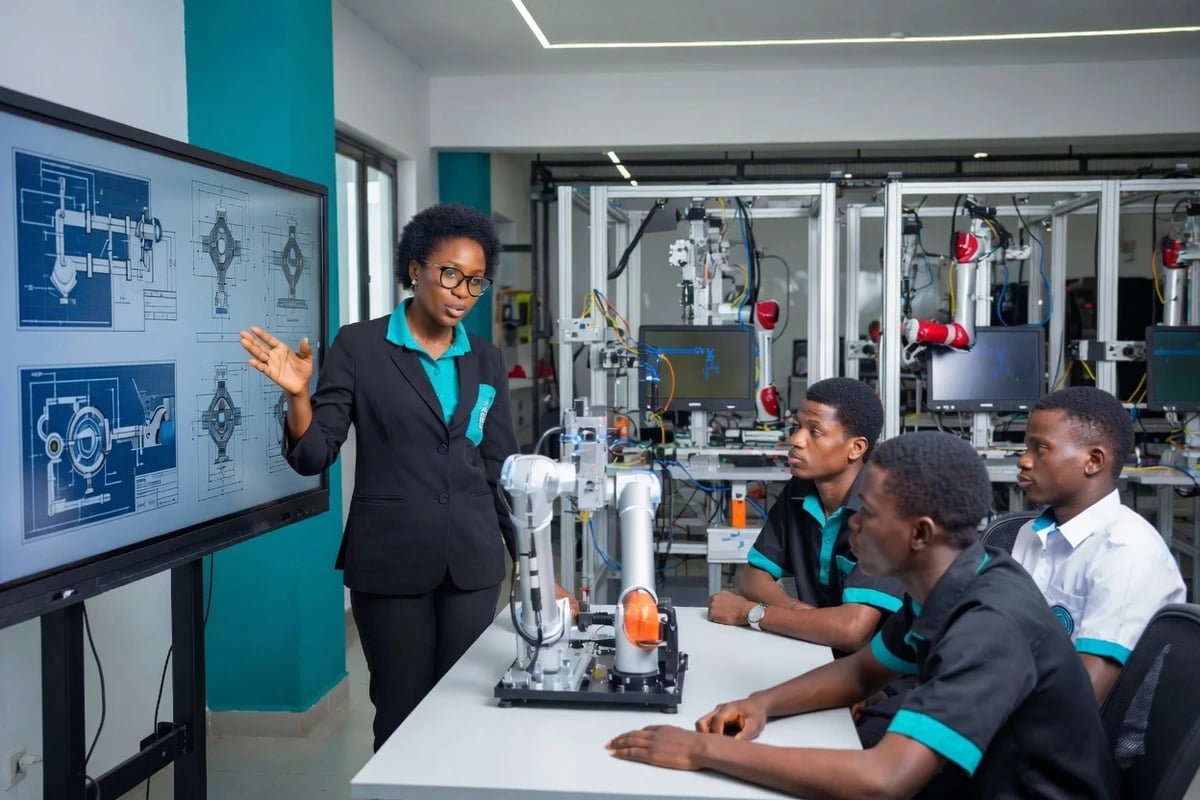
Delivery combines hands-on practical sessions conducted directly on the client’s deployed systems, structured theoretical modules aligned to regional operational conditions, and documented competency milestones at each programme stage. Facilitators are specialists with applied experience across the sectors RoboHub Africa serves — they do not deliver generic syllabi but adapt content to the specific configurations, environmental conditions, and workflow constraints of each facility.
Programme completion is formalised through a chain-of-custody documentation protocol: each participant’s competency level is recorded, assessed, and handed over to the organisation’s operational leadership through a structured capability register. This creates an auditable foundation for workforce planning, succession readiness, and future system expansions.
Programme Architecture
- Capability baseline assessment conducted prior to programme design — role-mapped, system-specific, and aligned to operational KPIs
- Structured learning pathways sequenced by role: operators, technicians, supervisors, and automation leads each receive differentiated content
- Hands-on practical modules delivered on live or parallel systems within the client’s own facility environment
- Documented competency milestones at each programme stage, with formal sign-off and chain-of-custody handover to operational leadership
- Refresher and advancement tracks available as systems evolve or new cohorts join the organisation
- Programme documentation package including participant records, competency registers, and recommendations for ongoing capability development
Typical Project Profile
A representative engagement covers a manufacturing or logistics facility operating across one or multiple sites in Ghana or Togo, with a workforce cohort ranging from frontline operators through to supervisory and technical leads. Programme duration is calibrated to team size and system complexity — typically structured across several weeks to allow practical application between sessions. Sectors served include food and beverage production, pharmaceutical and healthcare facilities, light industrial manufacturing, and distribution and logistics operations where automation forms a critical component of throughput.
Outcomes
- Operational teams capable of managing, monitoring, and troubleshooting deployed automation systems without reliance on external intervention for routine issues
- A documented competency register that gives operational leadership a clear, auditable view of workforce capability across all automation-related roles
- Reduced system downtime attributable to operator error or undetected performance drift
- A sustainable internal knowledge base that absorbs new cohorts and supports system upgrades without restarting capability development from zero
- Measurable alignment between the performance specifications systems were commissioned to deliver and the day-to-day utilisation achieved by the trained workforce