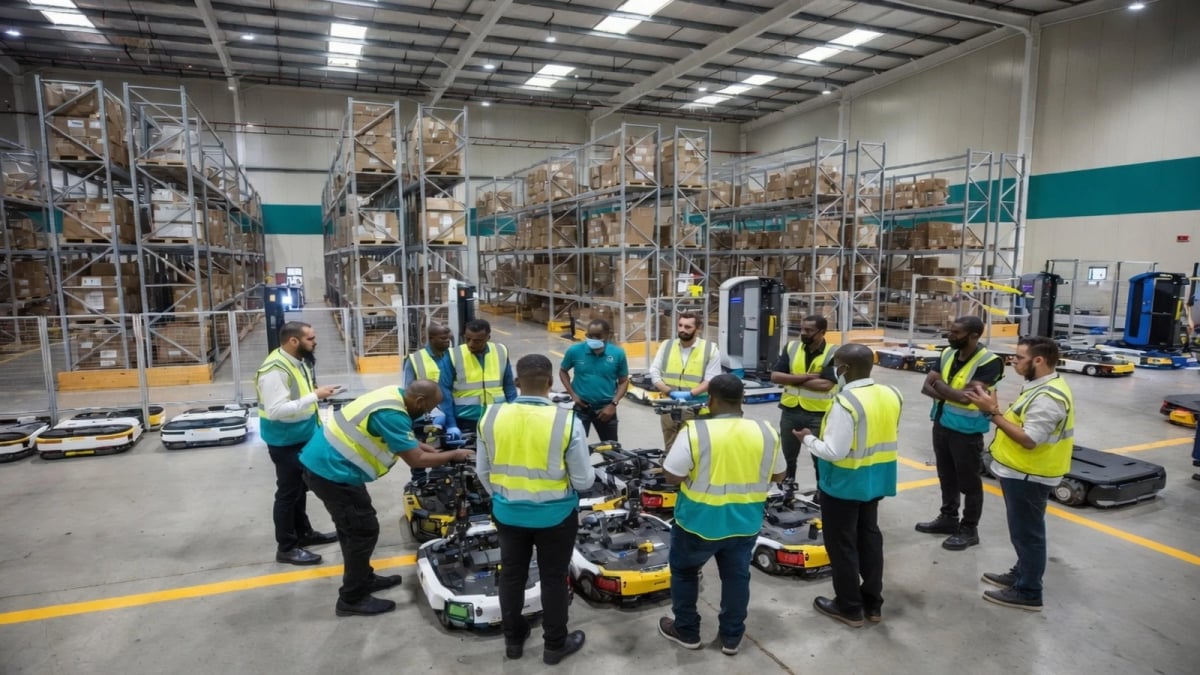
Robotics enablement for a warehousing operation
A warehousing operation required automation to address throughput constraints. The Project Office provisioned and deployed robotics solutions adapted to the existing layout, followed by managed support to sustain operational performance.
Project Profile
Sector: Logistics and Warehousing Scope: End-to-end robotics enablement — readiness assessment, system selection, integration advisory, operator training, and managed support transition Geography: Greater Accra, Ghana Timeline: Phased engagement over three quarters
A Tier-1 regional distribution operator managing high-throughput warehousing across the Greater Accra corridor engaged RoboHub Africa to evaluate and deploy robotic automation across their inbound sorting, pick-and-pack, and dispatch-staging workflows. The organisation had reached a throughput ceiling that manual operations could no longer sustainably address, and sought a structured advisory partner — not a hardware vendor — to guide a responsible, institution-grade transition.
The Specification Challenge
The engagement presented several compounding demands that elevated it beyond a standard technology procurement exercise.
The facility operated continuous shifts, meaning any transition to automated workflows had to be planned around zero-disruption windows. The existing warehouse management system had been customised over several years and carried integration constraints that a generic deployment approach would have broken. Beyond technology, the operator’s workforce — skilled and long-tenured — required a change management approach that preserved operational continuity and institutional knowledge rather than displacing it.
The client also operated under supply commitments to downstream partners, meaning any reduction in throughput during transition would carry commercial consequences. Precision sequencing of the enablement phases was non-negotiable.
Approach
RoboHub Africa opened the engagement with a structured readiness assessment: mapping current-state workflows, identifying automation candidates by ROI profile, and stress-testing integration compatibility with the live warehouse management environment.
From that diagnostic, a phased enablement roadmap was designed — sequencing the deployment of autonomous mobile robots across inbound sorting first, then expanding to pick-and-pack stations once the first phase had stabilised. Each phase included a parallel-run period in which human and automated workflows operated side-by-side, allowing the operator’s team to build confidence and competency before full handover.
RoboHub Africa’s specialists managed vendor selection, integration specifications, and acceptance testing — acting as the client’s technical authority throughout rather than deferring those decisions to hardware suppliers. Operator training was structured in-facility, across shifts, to ensure every team member interacting with the system could do so with confidence.
The engagement concluded with a managed support framework: a standing advisory relationship through which the client’s operational team could escalate performance queries, access optimisation reviews, and prepare for the next phase of capability expansion.
Outcome
By the end of the third quarter, the operator had achieved full robotic coverage across inbound sorting and pick-and-pack staging with no reportable disruption to downstream supply commitments. Throughput capacity increased materially above the pre-engagement ceiling. The workforce, retained in full, had transitioned into supervisory and exception-management roles — a deliberate design outcome, not an afterthought.
The managed support framework established at close of the engagement remains active, providing structured continuity as the operator evaluates further automation across their Togo-facing distribution nodes.
What This Project Demonstrates
High-throughput warehousing operations across Ghana face a structural inflection: the throughput demands of a growing distribution economy are outpacing what manual operations can reliably sustain. This engagement demonstrates that the path to robotics enablement does not require wholesale disruption — it requires sequencing discipline, integration rigour, and a specialist advisory layer positioned between the client’s operational reality and the technology market. Where those conditions are met, the transition strengthens rather than destabilises the institution.