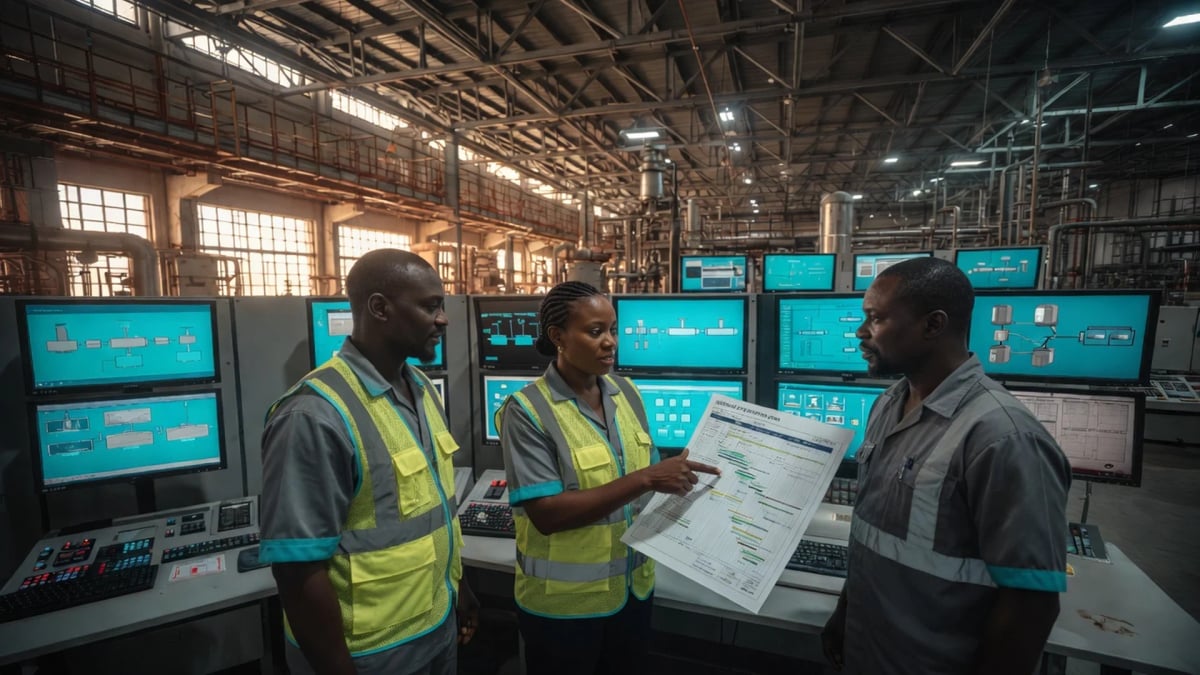
Managed automation support for an industrial operation in Togo
An industrial operation in Togo required ongoing managed support for its automation systems following initial deployment. The Project Office structured a managed support programme covering diagnostics, performance monitoring and scheduled maintenance.
Project Profile
Client type: Tier-1 Industrial Manufacturer — Lomé Corridor, Togo Scope: Managed automation support engagement covering post-deployment stabilisation, operator capability building, and ongoing advisory retainer Engagement model: Phased managed support programme — from initial systems audit through structured handover to sustained remote and on-site advisory
This engagement was initiated by a mid-scale industrial manufacturing operation in Togo’s Lomé Corridor — a facility producing fast-moving goods for regional distribution. The client had taken an initial step toward automation independently but encountered the challenge common to many first-generation deployments: machinery commissioned without a structured integration framework, operators trained on tasks rather than systems, and no institutional knowledge base to sustain the investment beyond the installation phase.
Specification Challenge
The project presented several compounding demands that placed it beyond a standard support brief.
The facility’s automation assets had been procured from multiple vendors across different generations of equipment — each with distinct communication protocols and maintenance rhythms. There was no unified supervisory layer, which meant downtime events were reactive rather than anticipated. Operator teams were confident with manual workarounds but had not internalised the logic of automated process sequencing.
Critically, the client operated across two shifts with no on-site automation specialist on either rotation. Any disruption cascaded into production loss before a qualified response could be assembled. The commercial consequence was measurable; the operational exposure was structural.
Approach
RoboHub Africa engaged the facility across three ordered phases.
The first phase was a full systems audit — mapping every automated asset against its current operational parameters, flagging integration gaps, and producing a structured risk register. This gave the client a single institutional view of their automation estate for the first time.
The second phase focused on capability building. Rather than training operators on isolated machine functions, the programme addressed process logic — how each automated node connected to upstream and downstream activity, where human decision points remained, and how early indicators of system stress should be read and escalated. Sessions were delivered in both English and French to reflect the facility’s workforce composition.
The third phase transitioned the engagement to an ongoing managed support retainer: scheduled remote monitoring, defined escalation pathways, quarterly on-site advisory visits, and a structured knowledge transfer protocol to build internal competence progressively rather than sustaining dependency.
Outcome
Over the course of the engagement, the facility moved from a reactive posture — characterised by unplanned stoppages and ad hoc responses — to a structured operational rhythm in which automation assets were managed proactively.
Operator teams demonstrated materially improved system literacy. Escalation times shortened as defined response protocols replaced improvised troubleshooting. The client’s operations management gained visibility over their automation estate that had not previously existed in any consolidated form.
The retainer structure gave the facility a predictable support cost and a named advisory relationship — replacing the fragmented vendor-by-vendor support model that had created gaps in accountability.
What This Project Demonstrates
Industrial operations in Togo and across the Ghana–Togo corridor frequently encounter automation investments that underperform not because the technology is wrong, but because the surrounding framework — integration architecture, operator capability, escalation structure, institutional knowledge — has not been built around the equipment.
This engagement illustrates that sustained automation value is a managed outcome, not a one-time deployment event. For manufacturers at this stage of operational maturity, a structured advisory and managed support partnership is the instrument that converts capital expenditure into durable production capability.