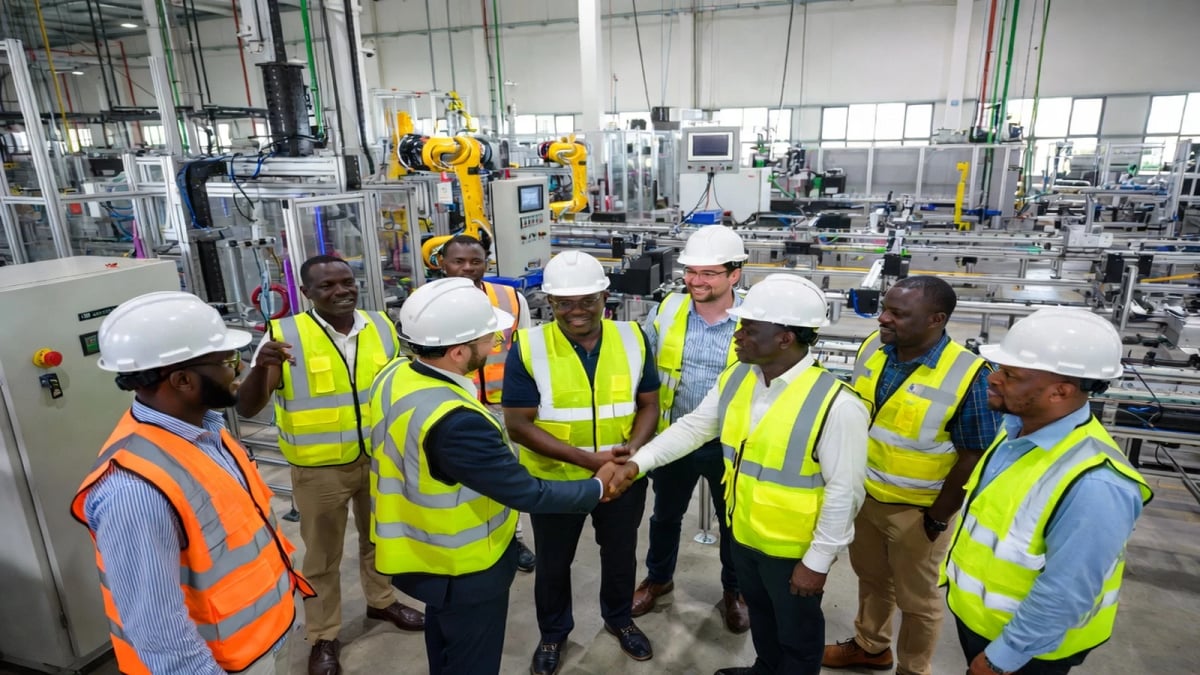
Phased automation programme for a manufacturing facility
A manufacturing facility sought to reduce manual handling and improve line consistency. The Project Office conducted a readiness assessment, designed a phased automation programme and delivered systems integration alongside operator training, reaching up to 99% automation across the targeted production lines.
Project Profile
Sector: Fast-moving consumer goods manufacturing Operation scale: Multi-line production facility with parallel packaging and quality-control workflows Scope: Phased automation programme — advisory, technology selection, deployment coordination, and managed support transition Timeline: Delivered across three structured phases over an extended engagement period
The Specification Challenge
The facility had reached a point where manual throughput could no longer keep pace with order volume. Production lines ran on inconsistent rhythms, quality-control checks were concentrated at end-of-line, and supervisory bandwidth was absorbed by reactive problem-solving rather than optimisation.
The complexity of this engagement was not technological alone. The client operated across multiple shifts, with a workforce accustomed to process-intensive manual workflows. Any automation programme that ignored that human dimension — deploying systems without preparing the teams who would operate alongside them — risked embedding resistance and underutilisation. Equally, the facility had no dedicated automation engineering function internally, meaning the programme required both technical deployment and institutional capacity-building from the outset.
The mandate was to automate progressively without disrupting active production, and to build internal capability in parallel — not as an afterthought.
Approach
The engagement opened with a structured diagnostic: mapping existing workflows, identifying throughput bottlenecks, and assessing supervisory and technical readiness across the teams involved.
From this foundation, a phased automation roadmap was developed — sequencing interventions by impact priority and operational risk, so that each phase could be validated before the next was initiated.
Phase one addressed the highest-friction production bottleneck: a manual batching and portioning station that created downstream queue accumulation. Automation here was specified to integrate with existing line architecture, minimising reconfiguration overhead.
Phase two introduced inline quality-sensing capability at two points in the production sequence, shifting quality assurance from end-of-line inspection to in-process detection — reducing rework exposure and improving output consistency.
Phase three extended automation into packaging coordination, synchronising line output with packaging feed rates and integrating basic supervisory dashboards accessible to shift leaders without specialist technical interpretation.
Throughout all three phases, structured capability-transfer sessions ran in parallel — ensuring that supervisory staff and line technicians could operate, interpret, and perform first-level maintenance on the deployed systems independently.
The final phase of the engagement transitioned the facility onto a managed support arrangement: scheduled system health reviews, remote monitoring protocols, and structured escalation pathways — sustaining performance without requiring the client to build a dedicated internal automation engineering team.
Outcome
Following programme completion, the facility demonstrated measurably more consistent throughput across production shifts. Supervisory time previously absorbed by reactive intervention shifted toward forward planning. Quality-control rework incidence reduced at both points where inline detection was deployed. Shift leaders reported significantly higher confidence in interpreting system data and initiating first-response corrective actions independently.
The managed support structure has since been extended beyond the original contract term — an outcome that reflects the operational reliability of the deployed programme.
What This Project Demonstrates
Manufacturing facilities across Ghana and Togo rarely lack the intent to automate. The constraint is almost always structural: no internal engineering function, no phased roadmap, and no framework for building operational capability alongside technology deployment.
This engagement demonstrates the RoboHub Africa programme model: advisory-led, phased, and oriented as much toward institutional readiness as toward system performance. Automation that outlasts the deployment team is automation built correctly.