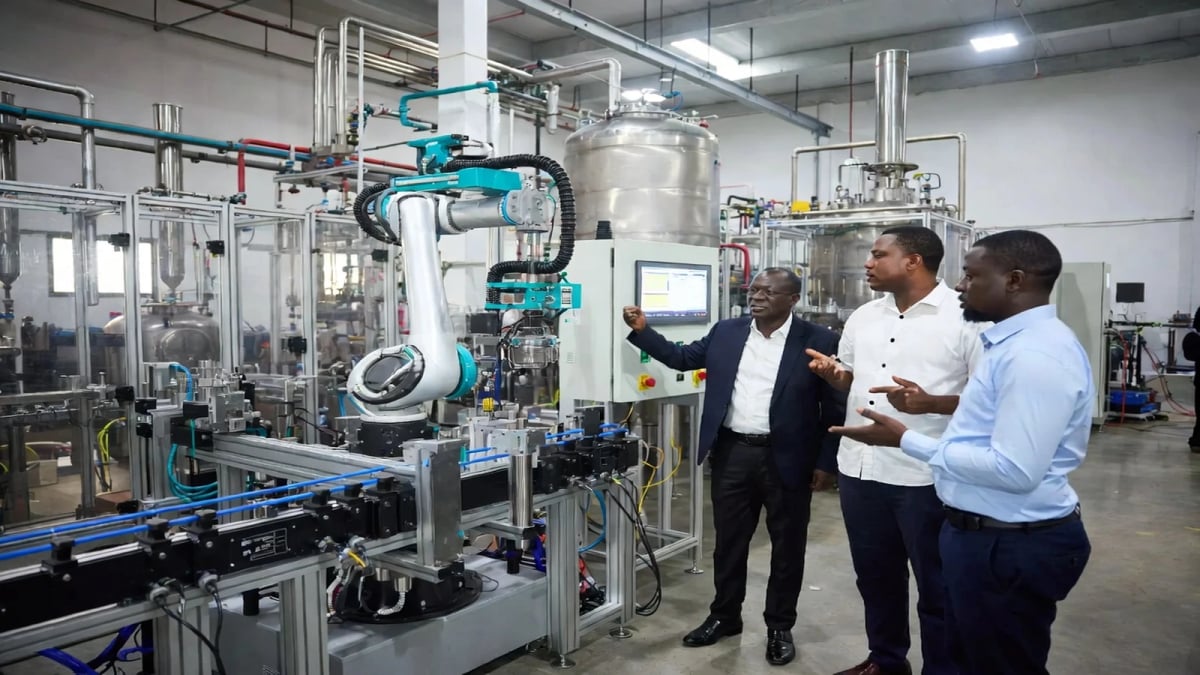
Custom automation provisioning for a food production line
A food producer required automation adapted to hygiene requirements and specific line configurations. The Project Office designed and provisioned a bespoke solution with process optimisation to improve throughput and output consistency.
Project Profile
Sector: Food production and processing Scope: End-to-end automation advisory, system design, and managed deployment across a primary production line Geography: Greater Accra industrial corridor, Ghana Engagement Model: Consultation through deployment with ongoing managed support
A mid-scale food production facility operating in the Greater Accra industrial corridor engaged RoboHub Africa to redesign and automate a high-throughput production line that had reached the ceiling of its manual capacity. The facility produced packaged consumer goods across multiple SKUs and required a solution that could accommodate product variability without sacrificing throughput consistency.
Specification Challenge
The facility’s production environment presented several compounding constraints that made standard automation templates unsuitable.
- SKU variability: The line processed multiple product formats across different weights, packaging geometries, and sealing requirements — demanding configurable automation logic rather than fixed-sequence machinery.
- Fragile throughput continuity: Any deployment approach that introduced extended line downtime risked contractual obligations with the facility’s distribution partners across Ghana and into Togo.
- Workforce integration: The client’s leadership was firm that automation could not simply displace floor workers — the solution needed to redeploy existing personnel into quality assurance, supervision, and process monitoring roles.
- Infrastructure readiness: Electrical supply consistency at the site required assessment before any automation architecture could be responsibly specified.
These conditions ruled out off-the-shelf automation packages and required a bespoke advisory and provisioning process from the first diagnostic session.
Approach
RoboHub Africa engaged the facility through a structured three-phase process.
Phase 1 — Diagnostic and Advisory: The engagement opened with a full operational audit: process mapping, bottleneck analysis, infrastructure assessment, and workforce capability review. This diagnostic produced a specification document aligned to the facility’s throughput targets, SKU profile, and operational risk tolerance.
Phase 2 — System Design and Provisioning: Drawing on the specification, the team designed a modular automation architecture combining programmable logic control, conveyor sequencing, and automated weighing and sealing stations. Modular design was central — each station could be reconfigured independently as the SKU mix evolved, without requiring full-line shutdown.
Phase 3 — Deployment and Managed Support: Deployment was phased to maintain partial line operation throughout. Following commissioning, RoboHub Africa remained engaged under a managed support arrangement covering system monitoring, operator training cycles, and periodic optimisation reviews.
Outcome
The commissioned line demonstrated measurable improvement across the facility’s key operational indicators. Throughput consistency increased substantially relative to the pre-automation baseline. Error rates at the weighing and sealing stations — previously a primary source of rework — declined to operationally negligible levels. Workforce redeployment proceeded as planned, with former line workers integrated into structured quality oversight roles supported by a training programme designed and delivered by the RoboHub Africa team.
The modular architecture has since accommodated two additional SKU introductions without requiring significant system redesign.
What This Project Demonstrates
Food production facilities across Ghana and Togo share a common constraint profile: variable SKU demands, infrastructure that requires careful pre-assessment, and workforces that represent institutional knowledge the organisation cannot afford to lose.
This engagement demonstrates that responsible automation provisioning is not a product sale — it is a structured advisory and enablement process. When automation is specified against a facility’s actual operational reality rather than against a catalogue, the result is a production system that compounds in value: adaptable as the product range evolves, supportable as the team grows, and built for the operating environment that actually exists.