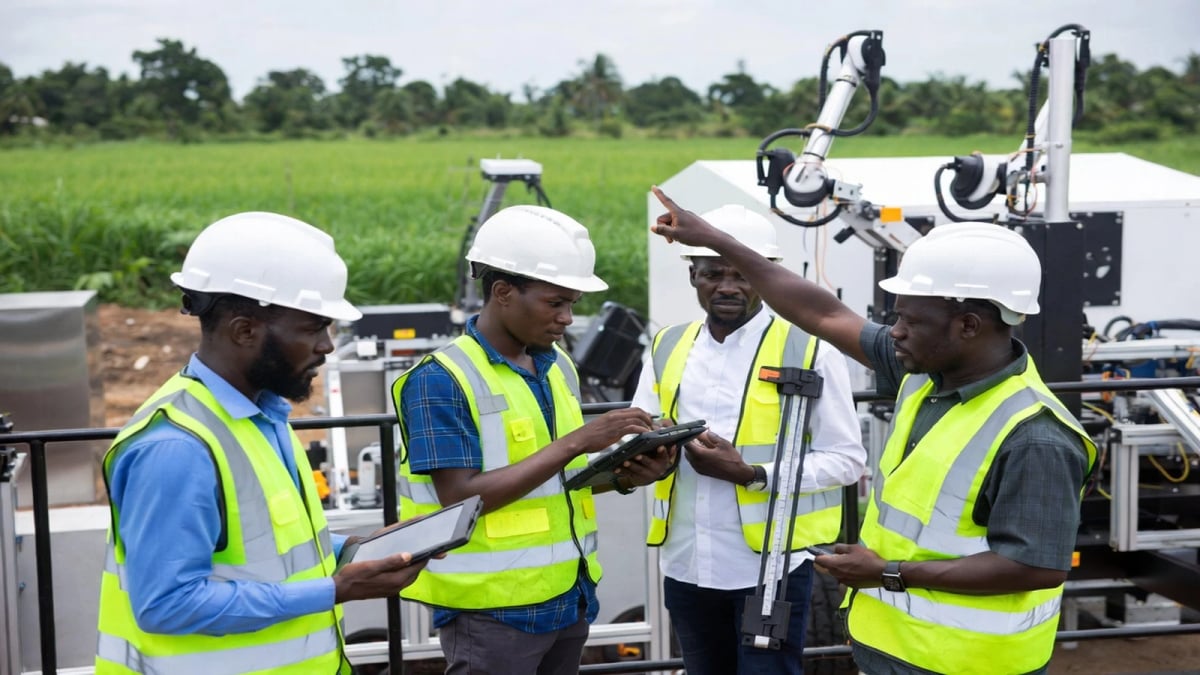
Automation readiness assessment and rollout for an agro-processor
An agro-processing operation required a structured path to automation. The Project Office delivered a readiness assessment, designed a phased provisioning roadmap and trained the operations team to manage the automated environment.
Project Profile
Sector: Agro-processing — primary crop handling and value-added production Scope: Automation readiness assessment, phased deployment roadmap, operator enablement, and managed support onboarding Location: Accra–Tema Industrial Corridor, Ghana Timeline: Initial assessment to first live deployment — twelve weeks
A mid-scale agro-processing facility operating across primary crop handling, milling, and packaged goods lines engaged RoboHub Africa to evaluate automation potential and build a structured path from manual-intensive operations toward repeatable, measurable process control.
The Specification Challenge
Agro-processing environments present a distinct advisory challenge. Production lines are rarely standardised — throughput volumes shift with seasonal crop cycles, humidity and particulate conditions stress instrumentation, and the workforce culture has been built around manual judgment rather than system-paced workflows.
The facility operated three separate production stages managed by different supervisory teams with no unified data layer. Decisions on line speed, batch sizing, and quality checks were informal and experiential. Leadership recognised the operational ceiling this created but required confidence — through evidence, not assumption — that automation investment would translate into sustained capability rather than equipment sitting idle after deployment.
Approach
RoboHub Africa deployed a structured four-phase engagement:
Phase 1 — Readiness Assessment A specialist advisory team conducted a full operational audit across all three production stages: mapping process flows, identifying manual intervention points, flagging data gaps, and benchmarking current throughput consistency. A readiness score was produced for each line, ranking automation suitability against process stability, operator capacity, and infrastructure constraints.
Phase 2 — Deployment Roadmap Rather than a single capital-intensive rollout, the advisory output recommended a sequenced approach — beginning with the most process-stable line to generate early performance evidence, building operator confidence, and allowing learnings to inform subsequent phases.
Phase 3 — Operator Enablement Parallel to initial deployment, structured capability sessions brought line supervisors and floor operators into the process. Enablement was designed to reduce dependency on external intervention — the goal being that facility staff could monitor, flag, and escalate system behaviour with confidence.
Phase 4 — Managed Support Onboarding Following go-live on the first line, the facility transitioned to RoboHub Africa’s managed support structure — with defined escalation protocols, remote monitoring coordination, and scheduled performance reviews built into the engagement.
Outcome
The first automated line demonstrated consistent batch output within the target parameters that had previously required continuous manual adjustment. Supervisor-led monitoring replaced reactive floor intervention as the dominant operating mode. By the close of the twelve-week engagement, the facility held a documented roadmap for the remaining two lines, an internally capable supervisory team, and an active managed support relationship providing continuity beyond the initial deployment.
Leadership reported that the phased approach — grounded in the readiness assessment rather than aspirational specification — gave the board the structured evidence required to approve subsequent investment phases with confidence.
What This Project Demonstrates
Agro-processing operations across Ghana carry significant automation potential that frequently goes unrealised — not from absence of will, but from absence of a structured path. Seasonal variability, multi-stage production, and mixed workforce capability demand an advisory methodology that begins with honest assessment rather than hardware specification.
This engagement illustrates RoboHub Africa’s core position: automation capability is built progressively, from readiness through deployment through enablement. The result is not a system installed and handed over — it is an organisation that understands, operates, and sustains what it has built.